
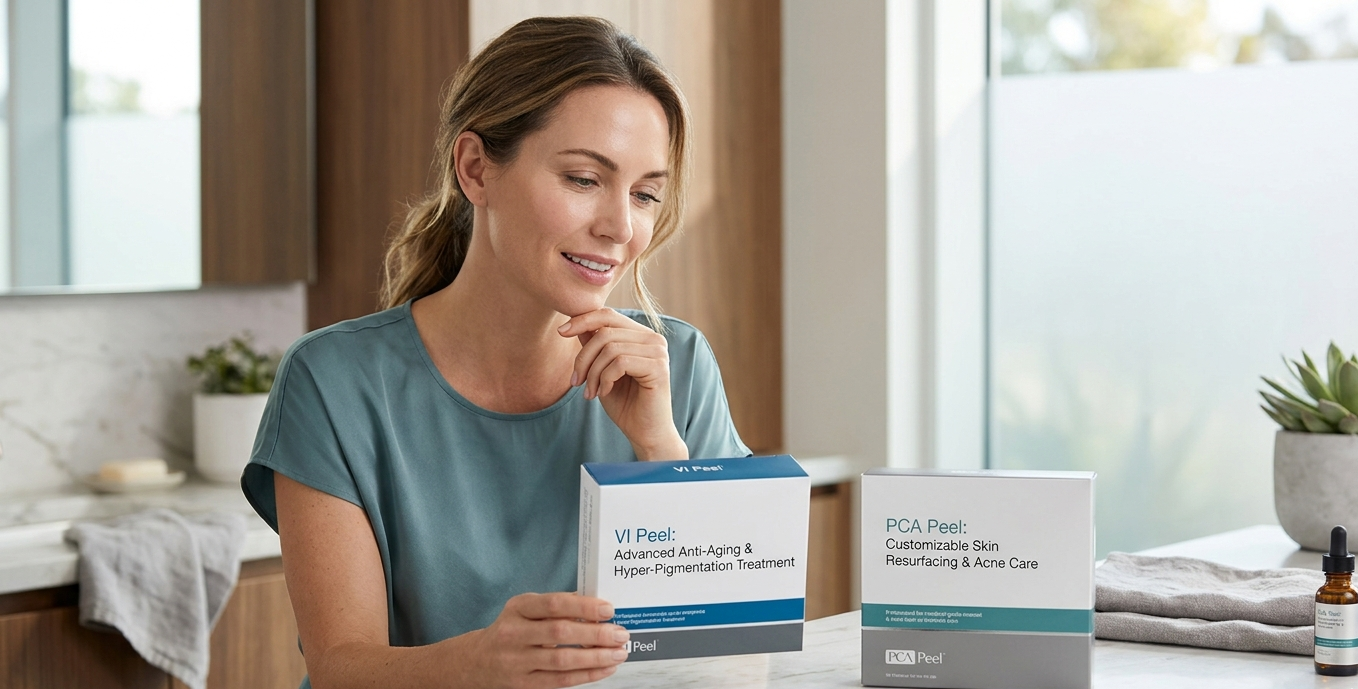
Chemical peels are among the most effective non-surgical treatments for improving skin clarity, texture, tone, acne, and early signs of aging. Two of the most commonly compared professional treatments are the VI Peel and PCA Skin Peels.
Both are widely used in medical spas and dermatology clinics. Both improve skin quality significantly. However, they differ in formulation style, customization, downtime, and how they deliver results.
This guide explains how each peel works, what skin concerns they treat, and how to decide which one is best for your skin goals.
1. What a Chemical Peel Does
A chemical peel is a controlled skin resurfacing treatment that uses acids to exfoliate the outer layers of the skin. This process removes dead skin cells and triggers new skin regeneration.
Chemical peels typically:
-
Exfoliate damaged skin layers
-
Improve skin tone and brightness
-
Reduce acne and clogged pores
-
Smooth fine lines and rough texture
Peels are generally categorized into:
-
Superficial peels that provide light exfoliation with minimal downtime
-
Medium-depth peels that create visible peeling and stronger correction
-
Deep peels that require medical recovery and produce dramatic resurfacing
VI Peel and PCA Skin Peels both fall into the superficial to medium-depth category depending on formulation and application.
2. What Is a VI Peel
The VI Peel is a branded medical-grade chemical peel system developed by Vitality Institute. It is designed as a standardized treatment with a consistent formula and predictable results across providers.
Key characteristics of VI Peel:
-
Pre-formulated and standardized peel system
-
Medium-depth chemical peel effect
-
Full face application treatment
-
Visible peeling typically occurs
-
Includes post-peel skincare kit
Common ingredients:
-
Trichloroacetic acid (TCA)
-
Salicylic acid
-
Retinoic acid
-
Phenol in select formulations
-
Vitamin C and other antioxidants
Primary goals:
-
Acne treatment and acne scar improvement
-
Hyperpigmentation reduction
-
Melasma management
-
Sun damage correction
-
Fine line reduction and skin rejuvenation
The VI Peel is often chosen for patients who want a noticeable and relatively fast skin transformation.
3. What Is a PCA Skin Peel
PCA Skin Peels are developed by PCA Skin, a professional skincare company widely used in dermatology and medical aesthetic clinics. Unlike VI Peel, PCA peels are not a single formula. They are a fully customizable peel system.
Key characteristics of PCA Skin Peels:
-
Fully customizable treatment system
-
Multiple peel formulations for different skin types
-
Layered application technique
-
Adjustable strength and depth
-
Can be tailored to sensitive or resilient skin
Common PCA peel categories:
-
Sensi Peel for sensitive or redness-prone skin
-
Ultra Peel for aging or dry skin
-
Acne-focused peel formulations
-
Pigment correction peels
Primary goals:
-
Acne management
-
Skin sensitivity support
-
Redness and rosacea-prone skin improvement
-
Hyperpigmentation treatment
-
Fine lines and uneven texture improvement
PCA peels are often used for long-term skin maintenance and customized treatment planning.
4. Core Differences Between VI Peel and PCA Peel
4.1 Treatment philosophy
VI Peel is a standardized system. Every treatment follows a similar formula and protocol. This creates consistency and predictable results. PCA Peel is a customizable system. The provider selects specific acids and layers based on the patient’s skin condition.
In summary:
-
VI Peel is standardized
-
PCA Peel is customized
4.2 Formulation approach
VI Peel uses a fixed combination of active ingredients designed to target multiple concerns at once. It typically combines stronger acids in one formulation. PCA Peel uses targeted acids such as glycolic acid, lactic acid, salicylic acid, and TCA depending on the specific peel type. The provider can layer or adjust the intensity.
VI Peel tends to be more uniform in strength, while PCA Peel is adjustable.
4.3 Depth and intensity
VI Peel generally delivers a consistent medium-depth peel effect. PCA Peel can range from very light superficial exfoliation to medium-depth resurfacing depending on the chosen protocol. This makes PCA more flexible for different skin conditions.
4.4 Downtime and peeling
VI Peel has a predictable downtime pattern:
-
Peeling begins around day 3 or 4
-
Visible peeling lasts about 5 to 7 days
-
Moderate flaking and skin shedding occurs
PCA Peel downtime varies significantly:
-
Light peels may cause minimal flaking
-
Medium peels may result in 3 to 5 days of mild peeling
-
Customization allows for reduced downtime in sensitive patients
VI Peel produces more consistent visible peeling, while PCA Peel allows for adjustable downtime.
4.5 Skin sensitivity
VI Peel is more intensive and may feel stronger during application. It is suitable for most skin types but may not be ideal for highly sensitive skin without preparation. PCA Peel is better suited for sensitive or reactive skin. Certain PCA formulations are specifically designed for redness-prone or easily irritated skin.
Overall, PCA is more adaptable for sensitive patients.
4.6 Results timeline
VI Peel typically delivers faster visible results due to its stronger formulation and peeling process. Many patients see noticeable improvement after a single session. PCA Peel results are often more gradual. Improvements build over multiple sessions and are designed for long-term skin health.
VI Peel focuses on faster transformation, while PCA Peel focuses on progressive improvement.
5. Skin Concerns and Effectiveness
Acne
VI Peel is highly effective for active acne and deep acne scarring due to its stronger exfoliating properties. PCA Peel is also effective, especially its salicylic acid-based acne peels designed for oil control and pore clearing. Both are effective, but VI Peel is often chosen for more aggressive acne correction.
Hyperpigmentation and melasma
VI Peel is exceptional for pigmentation correction and sun damage reduction, yielding faster visible improvement. PCA Peel also treats pigmentation well but typically requires a structured series of multiple sessions for optimal results.
Fine lines and aging skin
VI Peel provides strong collagen stimulation and visible resurfacing, making it highly effective for early aging concerns. PCA Peel is better suited for maintenance and gradual improvement in overall skin texture and elasticity. VI Peel is preferred for faster anti-aging correction, while PCA is better for long-term maintenance.
Sensitive skin and redness
PCA Peel is the clear winner for sensitive, reactive, or rosacea-prone skin. Certain PCA formulations are specifically designed to minimize irritation. VI Peel may be too strong for very sensitive skin unless the skin is carefully prepped and monitored beforehand.
6. Treatment Frequency
VI Peel is typically performed every 4 to 6 weeks. It is often used in short treatment series of one to three sessions. PCA Peel can be performed every 2 to 4 weeks depending on skin tolerance and treatment goals. It is often used in longer series of four to six sessions, making it highly flexible for ongoing maintenance.
7. Cost Differences
VI Peel is generally considered a premium branded treatment. It often has a higher per-session cost and includes a dedicated post-peel skincare kit. PCA Peel pricing varies depending on customization. Light peels are typically more affordable, while advanced customized treatments may cost more based on the layered protocol.
In general:
-
VI Peel is a fixed premium treatment
-
PCA Peel is a variable pricing system based on customization
8. Pros and Cons Summary
VI Peel Advantages:
-
Strong and predictable results
-
Effective for pigmentation and acne scars
-
Faster visible transformation
-
Standardized treatment experience
VI Peel Disadvantages:
-
Less customization
-
More noticeable downtime
-
Can be too strong for sensitive skin
PCA Peel Advantages:
-
Highly customizable treatment
-
Suitable for sensitive skin types
-
Adjustable downtime
-
Good for long-term skin maintenance
PCA Peel Disadvantages:
-
Results may be slower and more gradual
-
Requires an experienced provider for best outcomes
-
Less dramatic single-session results
9. Which One Should You Choose?
Choose VI Peel if you want:
-
Faster visible skin improvement
-
Strong correction of pigmentation or deep acne scars
-
A more intensive skin reset
-
Noticeable peeling and transformation
Choose PCA Peel if you want:
-
A fully customized treatment plan built for your specific skin type
-
High compatibility with sensitive or redness-prone skin
-
Gradual, highly controlled skin improvement
-
Long-term skin health maintenance
Final Conclusion
VI Peel and PCA Peel are both highly effective professional chemical peels, but they serve different purposes.
VI Peel is best for patients who want a stronger, faster, and more standardized resurfacing treatment with visible peeling and quicker results. PCA Peel is best for patients who want a more customizable, gradual, and skin-type-specific approach that can be adjusted for sensitivity and long-term maintenance.
In many clinical settings, both are used strategically depending on the patient’s skin condition and goals rather than being viewed as direct competitors.
